03 / Benchmarks
Useful sanity checks, not victory laps
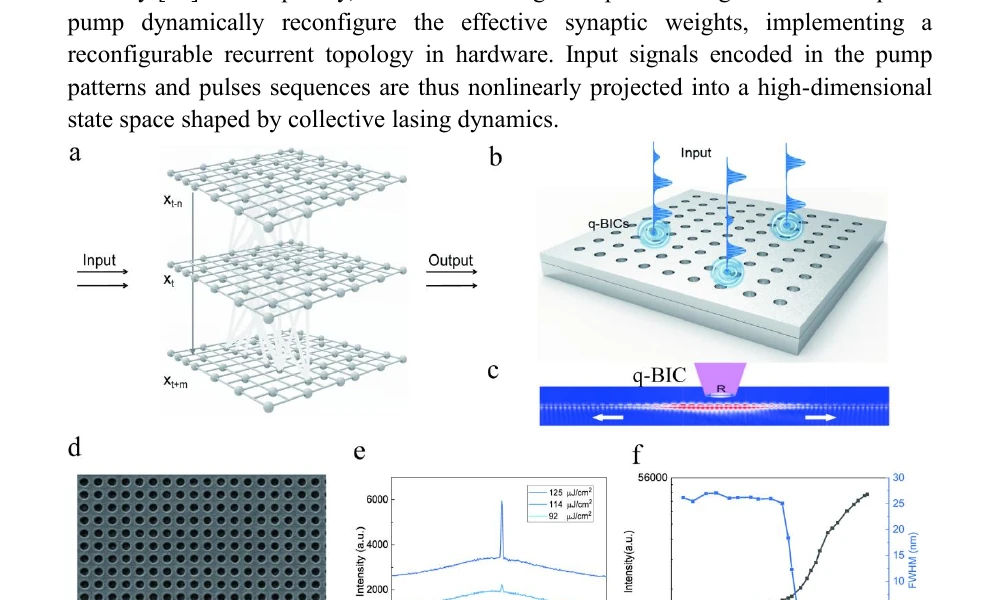
The benchmark section matters because it shows the physics can map into useful features. It does not yet show real-world competitiveness against mature ML pipelines.
Static task / MRI classification
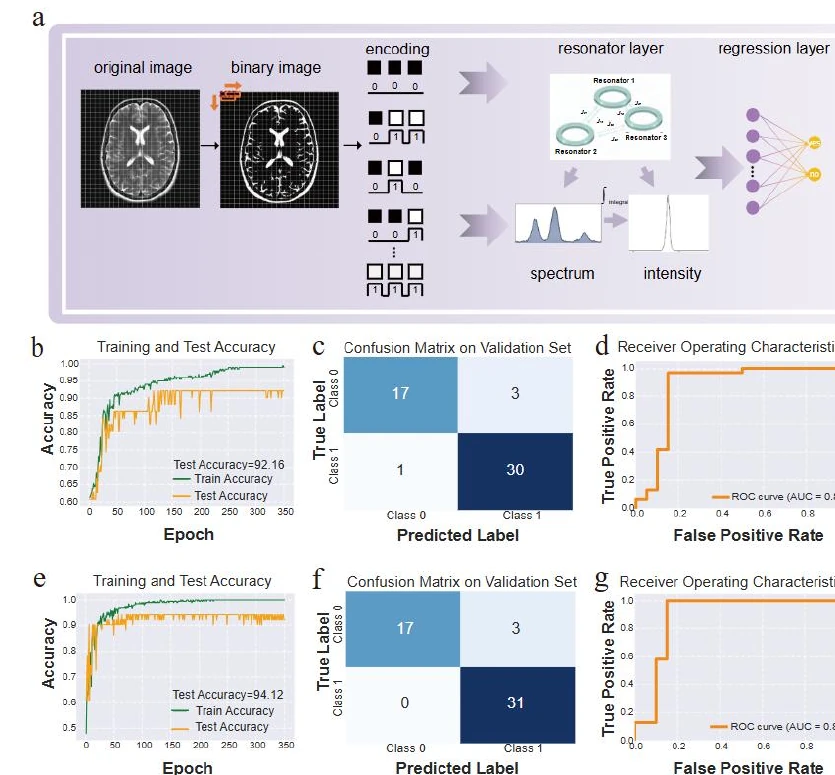
The paper binarizes MRI images to 30 x 30 and encodes consecutive triplets of columns as three-bit vectors before optical projection. Reported accuracy rises from 90.20% with integrated intensity to 92.16% with spectral readout, which is exactly what one expects if richer state readout improves separability.[1] [13]
Intensity readout90.20%
Spectral readout92.16%
AUC0.87 / 0.89
Dynamic task / action recognition
The NTU RGB+D stream is converted into binary frames, standardized to fixed length, and differenced before optical encoding. The reported gain from 81.49% to 85.36% matters because it isolates the value of the nonlinear spatiotemporal reservoir, but the input has already been significantly cleaned upstream.[1] [12]
Linear baseline81.49%
Spatiotemporal encoding85.36%
Absolute gain+3.87%
04 / Audit
Where the paper is strongest and where it is still aspirational
A cleaner site should not hide the caveats. It should make them easier to keep adjacent to the main claim.
Strongest proof
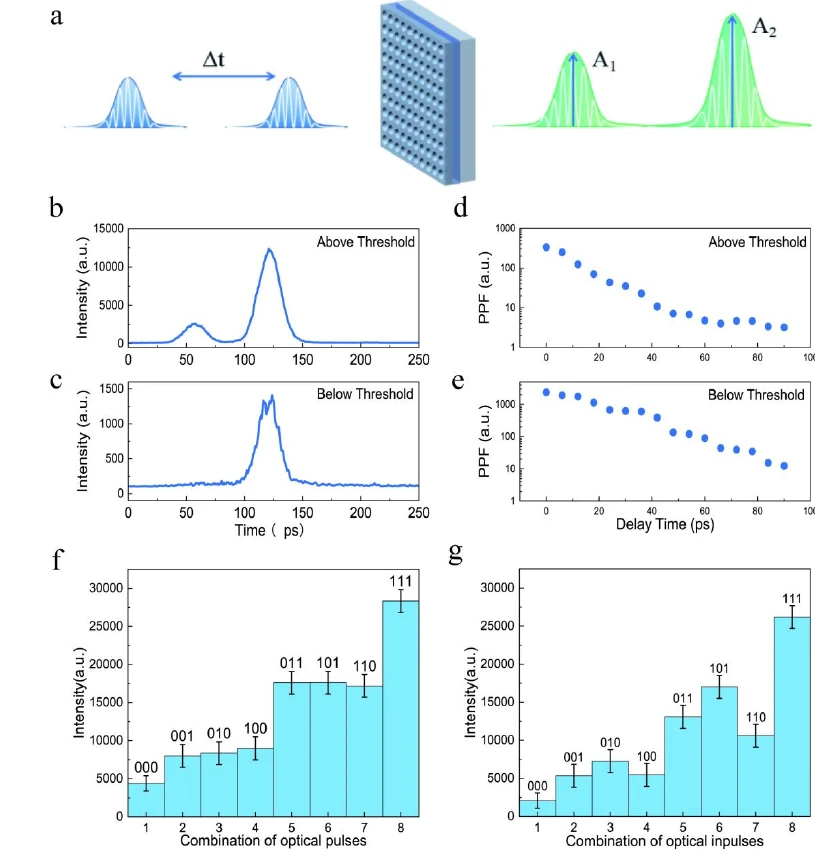
Temporal-memory evidence is experimentally direct
The paired-pulse result is exactly the kind of figure that converts a materials curiosity into a genuine computational substrate.
Biggest missing piece
System-level throughput and integration
The paper does not yet show the pumping, readout, and calibration path that would be needed for infrastructure relevance.
Best consultant-tier take
Substrate thesis, not product thesis
The right commercial imagination is optical feature extraction and later cascaded recurrent photonic systems, not immediate replacement of digital accelerators.
Object-level read
The paper is already strong enough to matter scientifically because it unifies the three hard ingredients in one fabricated substrate. It is not yet strong enough to settle the system question, which is why the strategy chapter matters.